Docker and a supported NVIDIA GPU on Windows or Linux. Measured whole-device peaks were 6.3–6.7 GiB for 0.6B checkpoints and 8.0–9.3 GiB for 1.7B checkpoints on RTX 5070 Ti.
Complete local voice studio Stable v1.0 or rolling latest
Faster Qwen3-TTS Studio
Design, clone, direct, and stream voices on your own GPU.
A local Qwen3-TTS workspace for voice design, consented reference cloning, built-in speakers, multilingual streaming, SSML-H dialogue, reusable voices and scripts, and OpenAI-compatible applications.
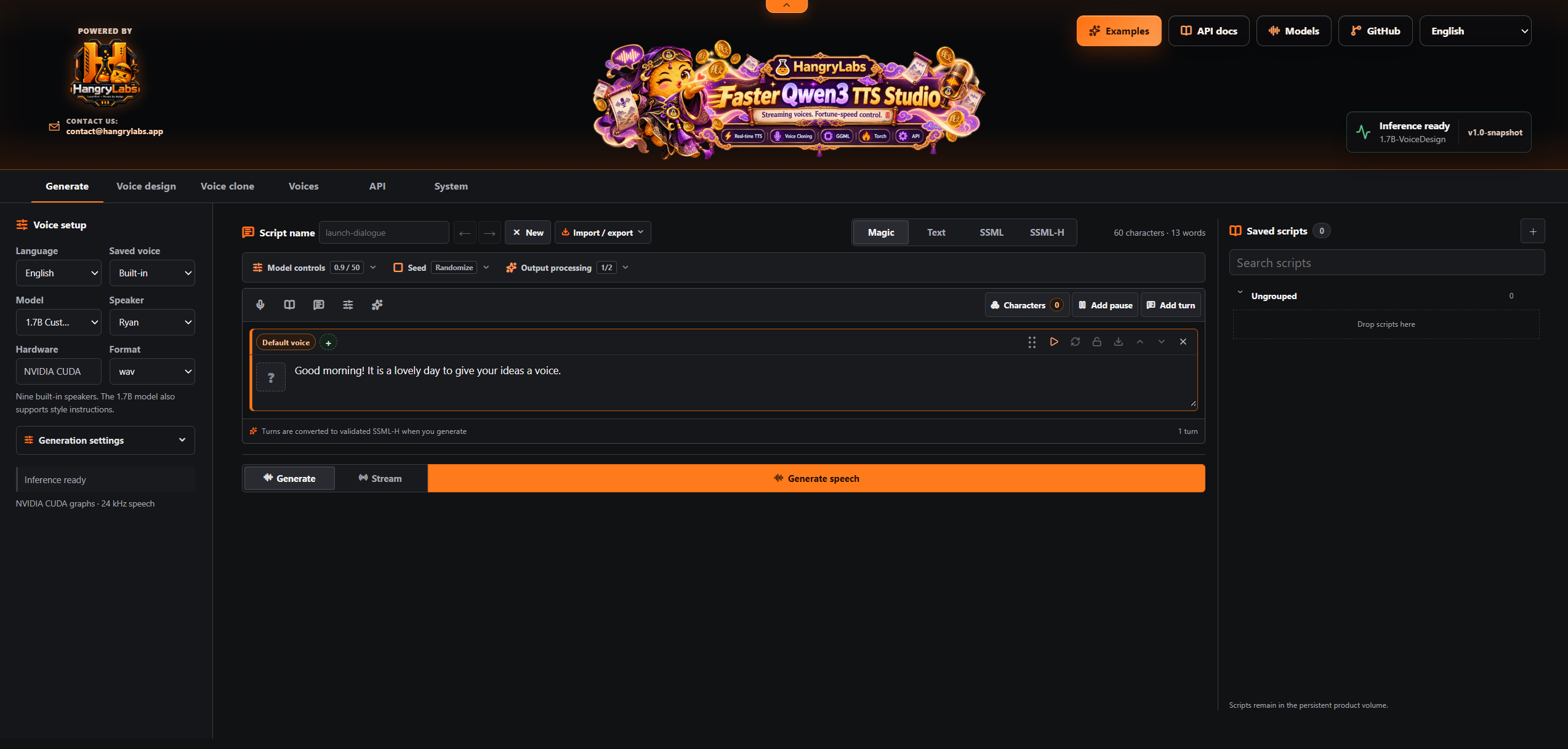
Open Generate for a built-in speaker, Voice design to describe a new voice, or Voice clone to record or upload a consented reference. Voices saves reusable references; API and System expose integrations and GPU controls.
Text, reference recordings, saved voices, scripts, and generated audio stay on the machine running the Studio. Optional transcription sends a reference only to the independent ASR service you explicitly configure. Clone only voices you have permission to use.
What is included
A complete local workspace, not just a model.
- Voice design, reference cloning, and nine built-in speakers
- Ten speech languages plus automatic selection
- Streaming playback, live WebSocket API, and seven OpenAI-compatible formats
- Magic dialogue, SSML, and SSML-H designed characters
- Saved voices, scripts, reusable takes, and workspace snapshots
- FIFO progress, cancellation, model residency, and GPU telemetry
The actual application
One workspace for design, cloning, dialogue, and delivery.
Generate uses built-in speakers, Voice design creates new references from a description, and Voice clone accepts recorded, uploaded, or saved voices. Magic preserves dialogue takes and scripts, while API and System expose integration, models, and GPU state.